From the Room Issue
Each season, a constellation of international voices sheds light on the theme of our issue. This new opus brings together Belgian fashion designer Julie Kegels; Hemal Seth and Ali of Casa Magazines, the New York mecca of independent press; and Benjamin Belaga, founder of the Parisian vinyl temple Yoyaku Records. So, what about room?
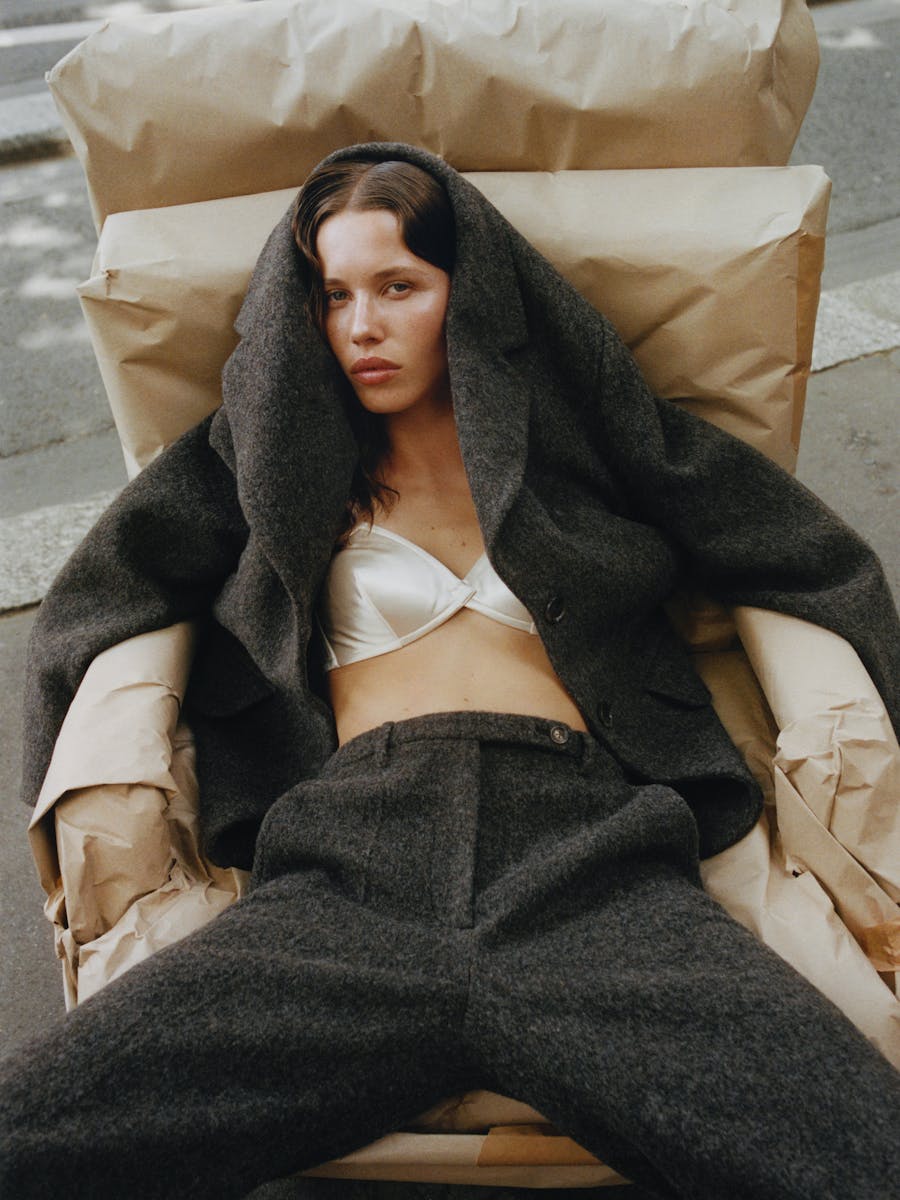
For young designer Julie Kegels, clothing is never singular: it is layered, intuitive, and deeply connected to real experience—designed not to impose identity, but to leave room for it, in all its multiplicity.
Speaking with Julie Kegels, there is a sense of movement: between thought and instinct, fantasy and everyday life. Based in Antwerp and showing in Paris, the Belgian designer approaches fashion as something lived rather than fixed, attentive to how women move through the day, through roles, through rooms. Her work draws on domestic spaces, workplaces, and the in-between moments, combining elegance with humour and imperfection.
Could you tell me about your background ?
JULIE KEGELS Becoming a fashion designer was always my dream. It was just always there. From a very young age, my parents gave me books about fashion and design, and they took us to museums constantly. We travelled a lot, visiting churches, villages, museums, even searching for fossils in the mountains. There was always culture and history around me.
You studied at the Royal Academy of Fine Arts in Antwerp. What did that time give you ?
J.K. I started very young, at eighteen, and that really helped. I hadn’t studied fashion anywhere else, so the Academy could shape me. It’s very focused on intuition and honesty—learning to feel when something is right or wrong. The teachers are strict, but they really push you to find your own world. I learned how to trust my gut.
What felt important to establish when you started your own label ?
J.K. I wanted to create a brand where I could truly translate my ideas into garments, always starting from real life. I’m very interested in how women actually live their days—the contrast between fantasy and reality. A woman is never just one thing. She moves through different identities during the day, and all of those versions exist at the same time. That tension is always at the heart of my work.
Your collections often explore transformation. Where does that come from ?
J.K. It comes from everyday life. Things are never perfect all the time. You rush, your clothes shift, something feels a bit off. I love that. I’m very interested in the balance between perfection and imperfection, and in taking those small, messy moments and turning them into something beautiful. That’s also how life feels to me: very layered, very human.
Humour plays an important role in your work. Why does that matter to you ?
J.K. I don’t take myself too seriously. I love playing with appearances: what you show on the outside versus what’s underneath. In Flemish, we say something like “falling through the baskets,” the moment when the mask drops and something real appears. My clothes are chic, but never boring. There’s always a twist, something human, slightly funny.
Space and interiors often feed into your collections. How does that influence your thinking ?
J.K. I’m always inspired by spaces. For one collection, I was influenced by a book about executive offices and how interiors were used to signal success — wood, carpets, curtains, specific chairs. The idea was that if you have the “right” space, you must be successful. I found that way of thinking fascinating, and also quite funny. I started translating those ideas into clothing—tailoring, strong shoulders, silhouettes associated with power. It made me question how success is staged, and how easily we believe in it.
That collection also raised questions around success more broadly. What interested you about that idea ?
J.K. I wasn’t trying to criticise it, but to understand it. How we recognise success, how we perform it, how we believe in it. A room can already tell a story before a person even
enters it.
Your show locations feel very considered. How do you think about space when presenting a collection ?
J.K. Space is extremely important to me. From the beginning, I usually have a strong feeling for the kind of place I want. Showing under the metro was perfect for a collection about rushing, changing quickly, moving between identities. It’s an in-between space, somewhere you never stay. Everything has to work together: the clothes, the music, the location. I want it to feel like a complete world.
How do you hope the brand grows from here ?
J.K. I hope it grows slowly and sustainably, step by step. I don’t want to rush or forget what matters. For me, success isn’t about speed: it’s about staying honest and emotional. I hope the brand becomes a place people feel connected to, where they can dream, remember, and feel something real.